12 Days of Winter Play: Why Small Moments Matter More Than Ever
If you pay attention long enough, you start to notice a pattern about winter. It’s not the holidays that make people unravel a bit — it’s the stretch of cold, gray days where everyone is stuck inside, pacing the same ten feet of hallway like a zoo animal who used to roam miles. Kids bounce off the walls. Teens disappear into glowing rectangles. Adults try to remember the last time they felt something other than cold or tired.
This is when play becomes less of an add-on and more of a survival tactic.
Not play in the polished, curated sense. Not the version that comes with matching pajamas and a photo session. I’m talking about the kind of play that fits into actual households — the messy, improvised, low-cost kind that lightens a day before anyone realizes why they feel better.
That’s what our 12 Days of Winter Play is built for. Small actions, big payoff. Activities that work for kids, teens, and adults alike, because everyone needs a break — even if they won’t admit it.
Here’s what each day actually does for the human brain and spirit, even if it just looks like fun from the outside.
DAY 1 — Cozy Scavenger Hunt
Cozy Scavenger Hunt
Kids: Find simple items (a soft thing, something red, something shiny).
Teens: Photo scavenger hunt using phones- first one to capture all items wins.
Adults: “Mindful hunt”—find 5 items that spark comfort or nostalgia.
Most people think a scavenger hunt is about finding stuff. Really, it’s about redirecting attention.
Kids practice focus. Teens learn to look up from their screens long enough to see the world again. Adults get a moment of nostalgic grounding that steadies the nervous system.
DAY 2 — Blanket Fort Village
Blanket Fort Village
Kids: Build a fort and add flashlights and books.
Teens: Build competing forts and judge for style/vibes.
Adults: Create a cozy reading or journaling nook for yourself.
Architects will tell you: structure creates safety.
Kids feel anchored inside a little world they built themselves. Teens enjoy the competition of building something “better.” Adults rediscover the simple comfort of carving out a quiet corner just for themselves — a rare luxury in winter.
DAY 3 — Hot Cocoa Taste Test
Kids: Try toppings—sprinkles, marshmallows, whipped cream.
Teens: Create “signature cocoa recipes” and rate them.
Adults: Try a dark chocolate or cinnamon blend; pair with quiet music.
Flavor is memory’s oldest trick.
Kids experiment with choices. Teens flex their identity-making muscles. Adults get a warm cup of something that tells their brain, You’re allowed to pause now.
It’s small, yes. But the nervous system listens.
DAY 4 — Winter Sensory Bin
Kids: Cotton balls, pinecones, scoops, toy animals.
Teens: Create an aesthetic “winter vibes” flat lay or mini diorama.
Adults: Build a simple grounding tray—smooth stones, scented pine, calming textures.
Humans are wired to explore texture and temperature — it regulates stress without us noticing.
Kids get safe sensory play. Teens create small “scenes” that give shape to their creativity. Adults rediscover tactile grounding after days of digital overload.
DAY 5 — Five-Minute Freeze Dance
Kids: Classic freeze dance with a favorite playlist.
Teens: Do a TikTok-style choreography challenge (no posting required).
Adults: Put on a song you love and move for five full minutes—no rules.
Movement is medicine, wrapped in a playlist.
Kids burn off energy. Teens get a chance to loosen the social armor. Adults reconnect with their own body, even briefly — something most winter days don’t encourage.
DAY 6 — Six-Step Obstacle Course
Kids: Step over pillows, crawl under a table, hop twice, clap, spin, high-five.
Teens: Timed course—create it, run it, improve it.
Adults: A simple mobility flow: step-over, toe taps, stretch, twist, reach, breathe.
Problem solving disguised as chaos.
Kids develop coordination. Teens get the rush of improving their time. Adults get mobility without calling it exercise. Everyone wins.
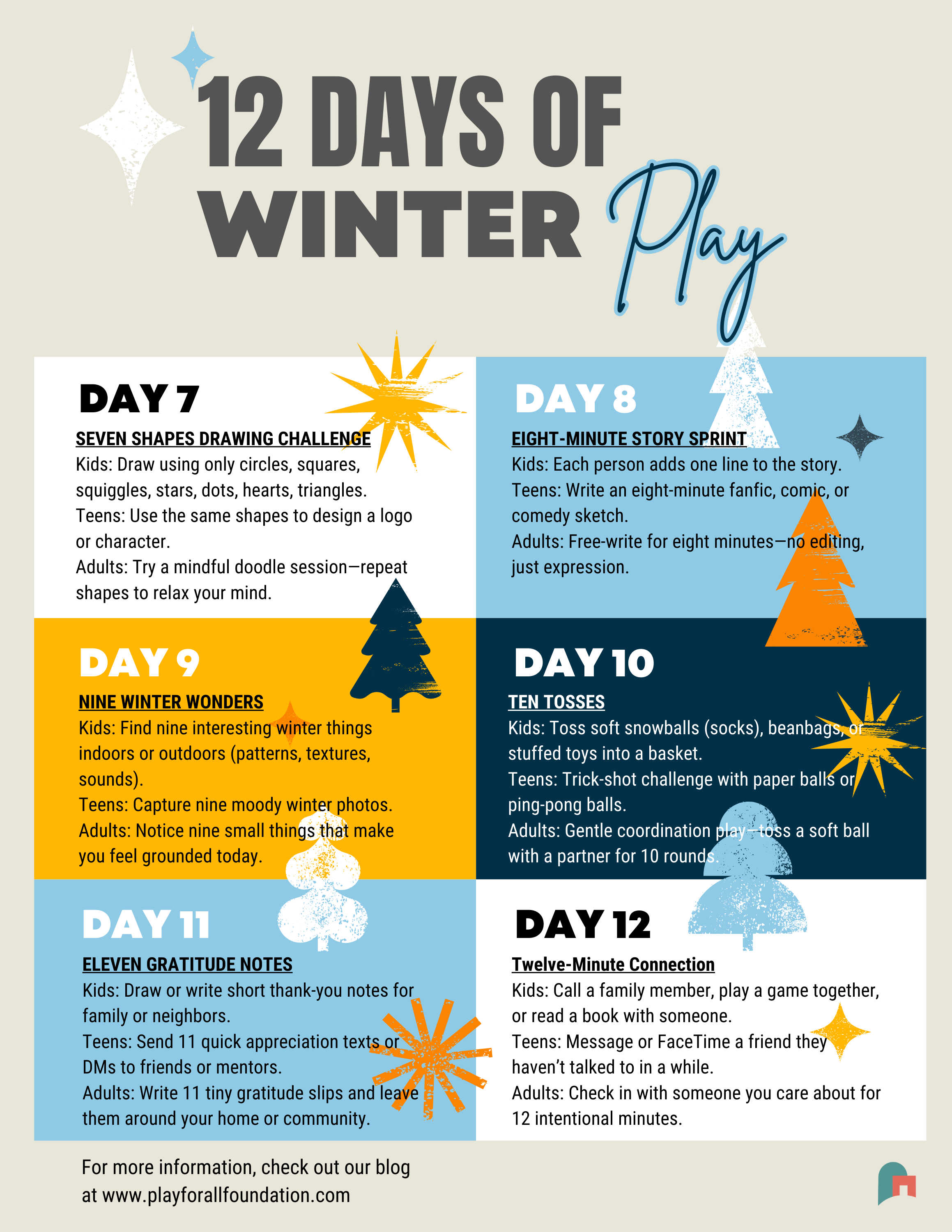
DAY 7 — Seven Shapes Drawing Challenge
Kids: Draw using only circles, squares, squiggles, stars, dots, hearts, triangles.
Teens: Use the same shapes to design a logo or character.
Adults: Try a mindful doodle session—repeat shapes to relax your mind.
Creativity isn’t about talent — it’s about permission.
Kids learn shapes and patterns. Teens practice low-pressure design thinking. Adults finally let their brain wander in a way that isn’t fueled by deadlines.
DAY 8 — Eight-Minute Story Sprint
Kids: Each person adds one line to the story.
Teens: Write an eight-minute fanfic, comic, or comedy sketch.
Adults: Free-write for eight minutes—no editing, just expression.
This is narrative play at its best.
Kids build imagination. Teens express themselves in ways they don’t always get space for. Adults unlock the therapeutic magic of writing something with no stakes.
DAY 9 — Nine Winter Wonders
Kids: Find nine interesting winter things indoors or outdoors (patterns, textures, sounds).
Teens: Capture nine moody winter photos.
Adults: Notice nine small things that make you feel grounded today.
Observing small things isn’t trivial — it’s the antidote to mental fog.
Kids notice textures and patterns. Teens sharpen their eye for mood and composition. Adults find grounding in noticing the tiny anchors that make a day feel manageable.
DAY 10 — Ten Tosses
Kids: Toss soft snowballs (socks), beanbags, or plush toys into a basket.
Teens: Trick-shot challenge with paper balls or ping-pong balls.
Adults: Gentle coordination play—toss a soft ball with a partner for 10 rounds.
Repetition creates rhythm — and rhythm calms the brain.
Kids practice coordination. Teens get a fun challenge. Adults reconnect through an easy, pressure-free physical moment.
DAY 11 — Eleven Gratitude Notes
Kids: Draw or write short thank-you notes for family or neighbors.
Teens: Send 11 quick appreciation texts or DMs to friends or mentors.
Adults: Write 11 tiny gratitude slips and leave them around your home or community.
Gratitude only sounds cliché until you watch what it does to a family’s energy.
Kids practice kindness. Teens reconnect with people they care about. Adults rebuild threads of community one note at a time.
DAY 12 — Twelve-Minute Connection
Kids: Call a family member, play a game together, or read a book with someone.
Teens: Message or FaceTime a friend they haven’t talked to in a while.
Adults: Check in with someone you care about for 12 intentional minutes.
Connection is the real currency of winter.
Kids thrive on shared attention. Teens need reminders that relationships don’t disappear just because the group chat went quiet. Adults carry the heaviest emotional load this time of year — so twelve minutes of presence can feel like a rare, meaningful gift.
The Bigger Story
The truth is, these aren’t just activities.
They’re small interventions in a season that often makes people feel stuck, isolated, or overwhelmed. Winter doesn’t ask for perfection — it asks for intention. A few minutes here, a tiny burst of creativity there, and suddenly the day feels lighter.
Play doesn’t solve everything. But it shifts the energy just enough to make winter feel less like something to endure and more like something to move through — together.
And that’s what Play for All Foundation is here for.